
Welcome to Justin's AE Senior Thesis e-Portfolio
Building Statistics
- Building Name: Earth and Engineering Sciences Building
- Location and Site: West Campus, Penn State University, University Park, PA 16802
- Building Occupant Name: College of Engineering and the College of Earth & Mineral Sciences
- Occupancy or Function Types:
- Primary Function: Educational
- Secondary Function: Laboratory
- Size (Total Sq. Ft.): 106,000 Sq. Ft.
- Number of Stories Above Grade: 4 Stories
- Primary Project Team:
- Owner: The Pennsylvania State University
- Architect: Herbert Beckhard and Frank Richlan / Joint Venture with L. Robert Kimball
- MEP Engineers: L. Robert Kimball
- General Contractor: Leonard S. Fiore Inc.
Website: www.lsfiore.com - Electrical Contractor:
Website: - Structural Engineers:L. Robert Kimball
Website: www.lrkimball.com - Bid: January 1998
- Started: May 1998
- Finished: December 1999
- Cost: $14 million
- General Contractor: $9 million
- Heating: $2 million
- Plumbing: $6.67 million
- Electrical: $1.7 million
- Project Delivery Method: Design-Bid-Build
- 4 Major Bid Packages
- Steel Construction
- General Construction
- Plumbing/HVAC
- Electrical
Website: www.psu.edu
Website: www.beckhardrichlan.com
Website: www.lrkimball.com
Building System Information:
Architecture:
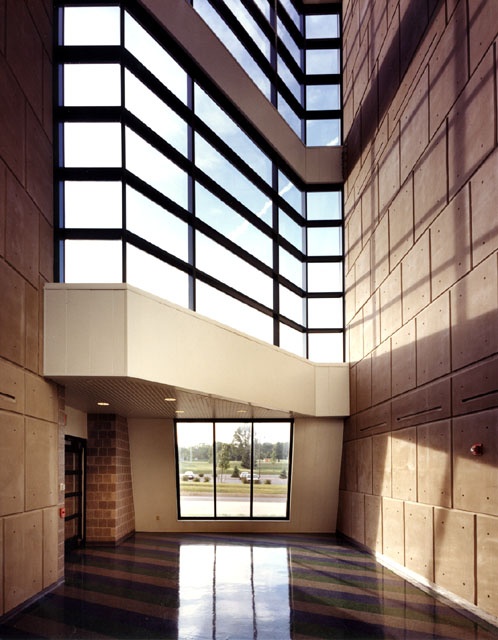 The
Earth and Engineering Sciences building at Penn State was the design of
the late Herbert Beckhard. The architectural duties of this project were
split between Herbert Beckhard, Frank Richlan and Assocaites and L. Robert
Kimball and Associates. The primary design and schematics were the responsibility
of Herbert Beckhard and Frank Richlan, with Penn State Alumnus Beckhard
handling the design. Located on a newly developed section of the Penn State
University Campus, Beckhard planned to design a monumental building and
leave a "legacy". The grand scheme of his design had to be scaled down on
numerous occasions, however the overall themes still remain. The 4 story,
106,000 Sq. foot educational facility houses several offices, a large computer
center, teaching and research laboratories, standard and special classrooms,
and a large lecture hall. A large percentage of the offices feature views
of either the quadrangle to the south or the golf course to the north. Natural
lighting was to be a main theme in the EES building a can be seen in the
use of several different styles of windows. These windows were meant to
reflect the diverse functions inside the building. The laboratories all
include windows and natural ventilation. The large auditorium style lecture
hall ties into the main complex in manner best described as unsubtle. It
almost becomes it's own element, but can still be identified as part of
the whole. The base of the building is a cut stone that provides an aesthetic
not often seen at Penn State, but was part of Beckhard's grand scheme.
The
Earth and Engineering Sciences building at Penn State was the design of
the late Herbert Beckhard. The architectural duties of this project were
split between Herbert Beckhard, Frank Richlan and Assocaites and L. Robert
Kimball and Associates. The primary design and schematics were the responsibility
of Herbert Beckhard and Frank Richlan, with Penn State Alumnus Beckhard
handling the design. Located on a newly developed section of the Penn State
University Campus, Beckhard planned to design a monumental building and
leave a "legacy". The grand scheme of his design had to be scaled down on
numerous occasions, however the overall themes still remain. The 4 story,
106,000 Sq. foot educational facility houses several offices, a large computer
center, teaching and research laboratories, standard and special classrooms,
and a large lecture hall. A large percentage of the offices feature views
of either the quadrangle to the south or the golf course to the north. Natural
lighting was to be a main theme in the EES building a can be seen in the
use of several different styles of windows. These windows were meant to
reflect the diverse functions inside the building. The laboratories all
include windows and natural ventilation. The large auditorium style lecture
hall ties into the main complex in manner best described as unsubtle. It
almost becomes it's own element, but can still be identified as part of
the whole. The base of the building is a cut stone that provides an aesthetic
not often seen at Penn State, but was part of Beckhard's grand scheme. The plan for the EES building had to compensate for a multiuse building. The building is shared by two separate colleges, each wanting their own identity, but remaining united. Beckhard had to connect two wings into one unified element. His original idea was to have a central core, which would share several core elements and a grand lobby area. The lobby area was to be made entirely of glass and feature several lounge spaces. However due to design restrictions this had to be modified into a smaller space with more miniscule glass slivers.
Building Envelope:
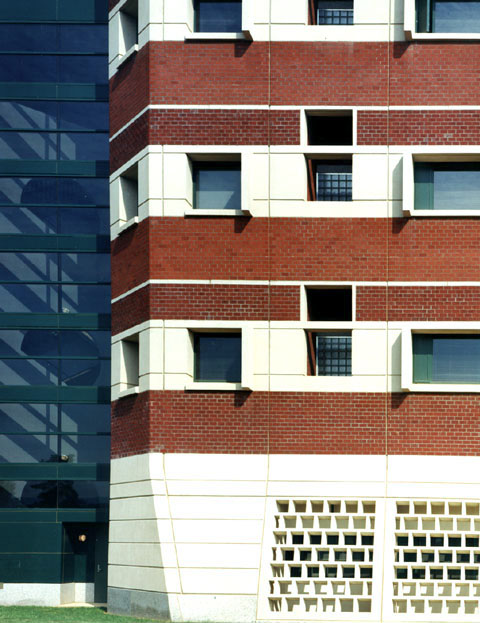 At the time of the design and construction phases
of the EES building a strict design criterion was intact at the Pennsylvania
State University. All building facades were to include a standard red brick.
Beckhard wanted to bend this rule a little and add a little bit of his own
personal touch to provide a design that could not be dated. The result was
a façade that included precast concrete panels, brick infill, and granite.
The use of the precast panels with "punchouts" allowed the façade to include
the brick elements that were required and at the same time provide a sleek
feel to the exterior. The precast panels surrounding window openings eliminated
the need for flashing and lintels, while relieving unwanted angles. The
bricks in the façade are actually two distinct tones of brick that are laid
in horizontal bands, going against the standard one tone brick façade criterion
seen on most of Penn State's campus at the time. The base consists of a
cut stone that sets of the remaining exterior elements. Concrete screens
can be seen outside of some classrooms, these were intended to break the
view of the façade and give a desired lighting effect inside the building.
The main entrance is a double entrance provided an air and sound barrier.
The doors are heavy() and feature glass inlays which provide and almost
airtight lock.
At the time of the design and construction phases
of the EES building a strict design criterion was intact at the Pennsylvania
State University. All building facades were to include a standard red brick.
Beckhard wanted to bend this rule a little and add a little bit of his own
personal touch to provide a design that could not be dated. The result was
a façade that included precast concrete panels, brick infill, and granite.
The use of the precast panels with "punchouts" allowed the façade to include
the brick elements that were required and at the same time provide a sleek
feel to the exterior. The precast panels surrounding window openings eliminated
the need for flashing and lintels, while relieving unwanted angles. The
bricks in the façade are actually two distinct tones of brick that are laid
in horizontal bands, going against the standard one tone brick façade criterion
seen on most of Penn State's campus at the time. The base consists of a
cut stone that sets of the remaining exterior elements. Concrete screens
can be seen outside of some classrooms, these were intended to break the
view of the façade and give a desired lighting effect inside the building.
The main entrance is a double entrance provided an air and sound barrier.
The doors are heavy() and feature glass inlays which provide and almost
airtight lock. Construction:
This project was partially funded by the state as a result the Department of General Services was a major player in the design and construction criteria for this project. Penn State also had a set of design criterion in effect. The site was new and virtually an undeveloped piece of land with maybe a few small parking areas. Geotechnical surveys had to be done to determine soil capacities. The most difficult restriction was the height limit. Construction was slowed as a result of the need to enclose the mechanical equipment without enough height to place the equipment on the roof. The final result was part of the equipment had to be moved to the basement. Budget issues also slowed the placement of the supercomputer which caused further delays. Other delays resulted from issues with site connections and ventilation stacks.
Zoning and Historical:
The construction site was an undeveloped region and was built on part of the PSU golf course.
Major National Codes:
IBC, BOCA, ASCE7
Electrical:
The electrical system starts with a pad mounted transformer as the main feed. The transformer provides 480/277 V phase current. The transformer feeds the main distributor panel which is routed to a switchboard. Emergency power supplied to the building by a second system. The first switchboard is the feed for 5 different panels: a 750 KVA transformer, basement distribution panel, outdoor lighting, Cray Computer lab, and a 75 KVA transformer. The 750 KVA transformer feeds two more distribution panels on the 1st and 3rd floors. The basement distribution panel provides power for corridor lighting, and each elevator.
Lighting:
Lighting for the EES building is predominantly flourescent. Emergency power is on a 120 V setting. Different fixtures can be found throughout the entire building. Several rectangular, louvered fixtures exist in the lab and classroom spaces. In the lobby fixtures are recessed under a metal slat ceiling. In the auditorium area wallwashers and downlights are used to achieve a variety of different lighting appearances. Corridor spaces utilize 2 X 2 recessed 9 cell parabolic lamp fixtures. In stairwells a standard sconce is used to provide lighting. Finally in the Cray Computer lab, lighting fixtures similar to those found in the other classrooms, are equipped with a dimmable center lamp ballast.
Structural:
The structural system for the Earth and Engineering Sciences building is composed of A36 grade steel used compositely with galvenized steel decking. Concrete floors are poured on top of the metal decking. A range of different beam and column sizes are used throughout the building and changed based on floor and location. There are some uses of 50 Ksi steel present in the structural system, these are typically utilized in the eastern wing of the building. The frame only uses moment connections in the long span direction of the southern wall, suggesting that an alternate lateral resisting system is required. In this case shear walls composed of reinforced concrete are located around stair wells, elevator shafts, and mechanical vents. These walls are reinforced with #5 bar size rebar spaced at 12". The entire building rests on a reinforced concrete foundation. The steel columns frame into concrete piers that distribute loads to the bearing soil below. The foundation mat is mainly slab on grade.
Fire Protection:
The entire building is equipped with full sprinkler systems and several standpipe locations. The building is in compliance with all ADA specifications. The building materials were required to all be non-combustible elements. Most structural elements consist of either concrete or encased steel. Special fire doors leading are automated and kick close in the event of a fire, to prevent further spread of the fire. Stairwells are all composed of stone. In the computer lab chemical compounds are dispensed in place of water to prevent damage to the computing systems.
Transportation:
The transportation system for this building is loacted in the central core or at the Eastern or Western most tips. This System consists of two elevators in the central core that provide access to all floors. Also loacted in this central core are two stariwells provided transporation by foot and in case of emergencies. At each end of the building another stair well is also located. All stairwells are fire resisting structures and are up to date with current fire codes.
Special Systems:
The addition of the Cray Supercomputer lab leads to several special provisions on this project. Special systems had to be installed to maintain and protect this lab. Lebert systems were installed to properly provide mechanical needs for this space. These systems helped to maintain a constant temperature and humidity level in the lab. An electrical system had to be installed to provide an ample energy flow to the computing systems as well as protect against electrical surge. A chemical fire system was also placed in this space. In addition to the computer center a distance learning center was also present, creating greater telecommunication needs. A vibrations lab is present in the basement of the complex. The large machine used to create the vibrations had to be placed on an isolation pad that would not induce seismic loads on the entire structure.